How you deliver a valuable ingredient matters just as much as the ingredient itself.
After vitamins, minerals and other active ingredients are taken orally, they pass through the digestive system. Throughout this process, factors such as the structure, solubility and formulation of an ingredient can influence how it is made available for use by the body.
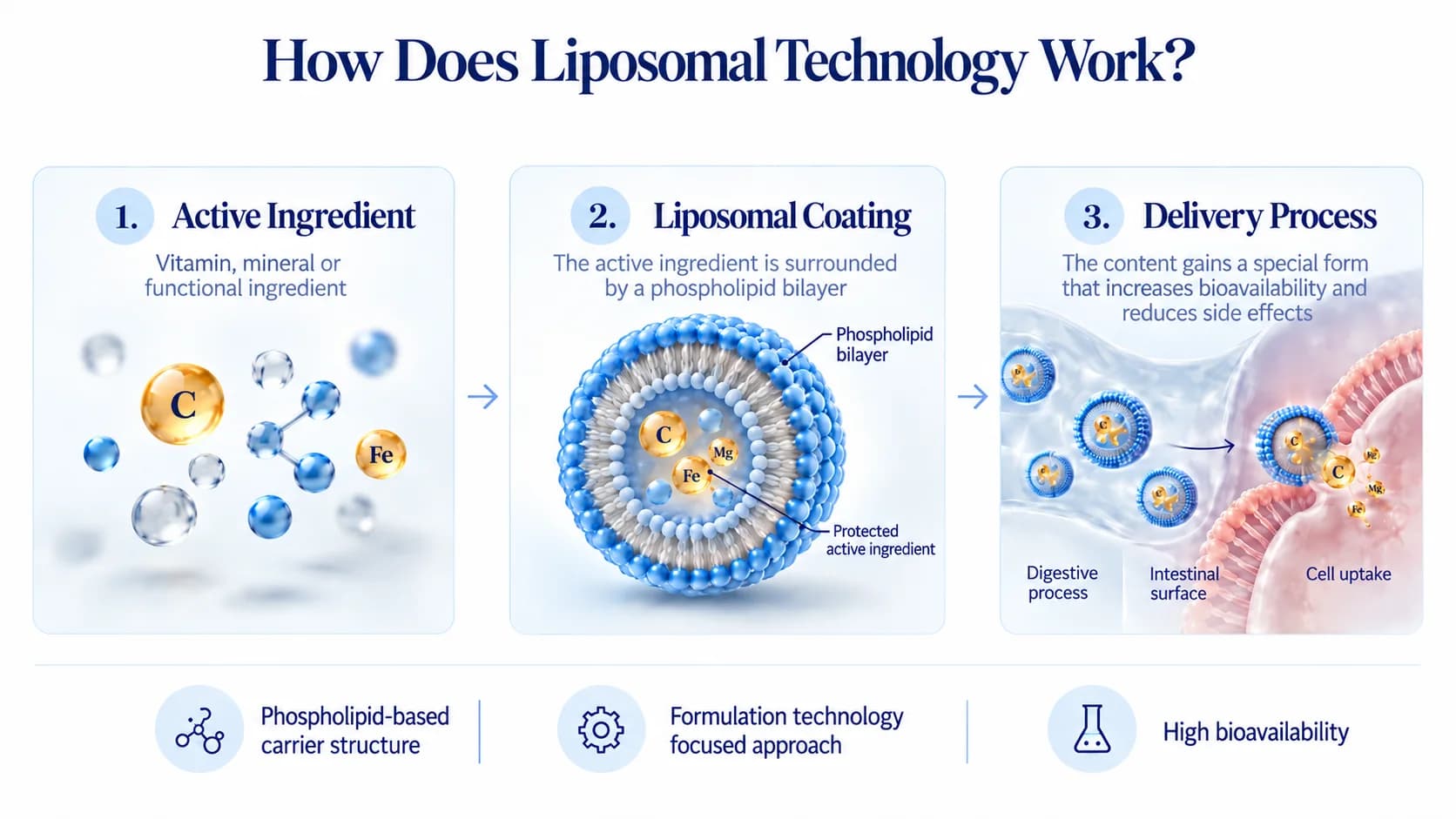
Liposomal technology is an advanced formulation approach based on carrying active ingredients within microscopic structures composed primarily of phospholipids.
These structures are known as liposomes.
Liposomes are extremely small carrier structures surrounded by phospholipids — fat-like molecules that are also among the fundamental components of human cell membranes.
Because of their unique structure, liposomes have been extensively studied for many years in pharmaceutical science, biotechnology and nutrition as delivery systems for a wide range of active ingredients.
Active ingredient → Encapsulated within a phospholipid structure → Carried through the digestive system in a specialized delivery environment
The quality of a food supplement is not determined solely by the amount of an ingredient stated on its label.
Another important consideration is the ingredient's bioavailability.
Bioavailability describes the proportion of an administered ingredient that becomes available for use by the body.
The same amount of an active ingredient may demonstrate different absorption and bioavailability characteristics depending on its formulation.
The primary purpose of liposomal delivery systems is to incorporate active ingredients into an appropriate lipid-based structure in order to optimize the physical and biological characteristics of the formulation.
Scientific studies suggest that, for certain vitamins and active compounds, liposomal formulations may demonstrate different — and in some cases higher — bioavailability compared with conventional formulations.
One of the defining characteristics of liposomes is their phospholipid bilayer structure.
Human cell membranes are also composed largely of phospholipids.
Because of this structural similarity, liposomes have been widely investigated as biocompatible carrier systems for the delivery of active compounds.
Simply describing a product as “liposomal” does not, by itself, indicate the quality or performance of the formulation.
Several factors may influence the characteristics and performance of a liposomal formulation, including:
Liposomal technology should therefore not be viewed simply as an ingredient claim. It is a comprehensive formulation system requiring scientific formulation expertise, appropriate manufacturing technology and rigorous quality control.
At Mediniti, we do not view liposomal technology simply as a term to place on a product label.
We consider it one of our core areas of formulation expertise and focus on developing delivery systems that are appropriate for the individual characteristics of each active ingredient.
From vitamins and minerals to functional ingredients, we combine a broad range of active compounds with modern formulation technologies.
Because for us, the important question is not only: “How much does it contain?” We also ask:
The scientific references above represent the broader scientific literature on liposomal delivery systems. The bioavailability and performance of an individual formulation may vary depending on the active ingredient, liposomal structure, formulation characteristics and manufacturing process.
